
Build it around why people buy, not what you sell. Gift shoppers arrive with three questions: what's the occasion, who is it for, and will it arrive in time. A Shopify gifting store answers them with occasion and recipient collections, a gift message at the cart, clear delivery cut-offs, and product pages that sell the moment, not the ingredients.
Nobody buys a box of chocolates for themselves. Fine, some of us do, but the store shouldn't be designed for us.
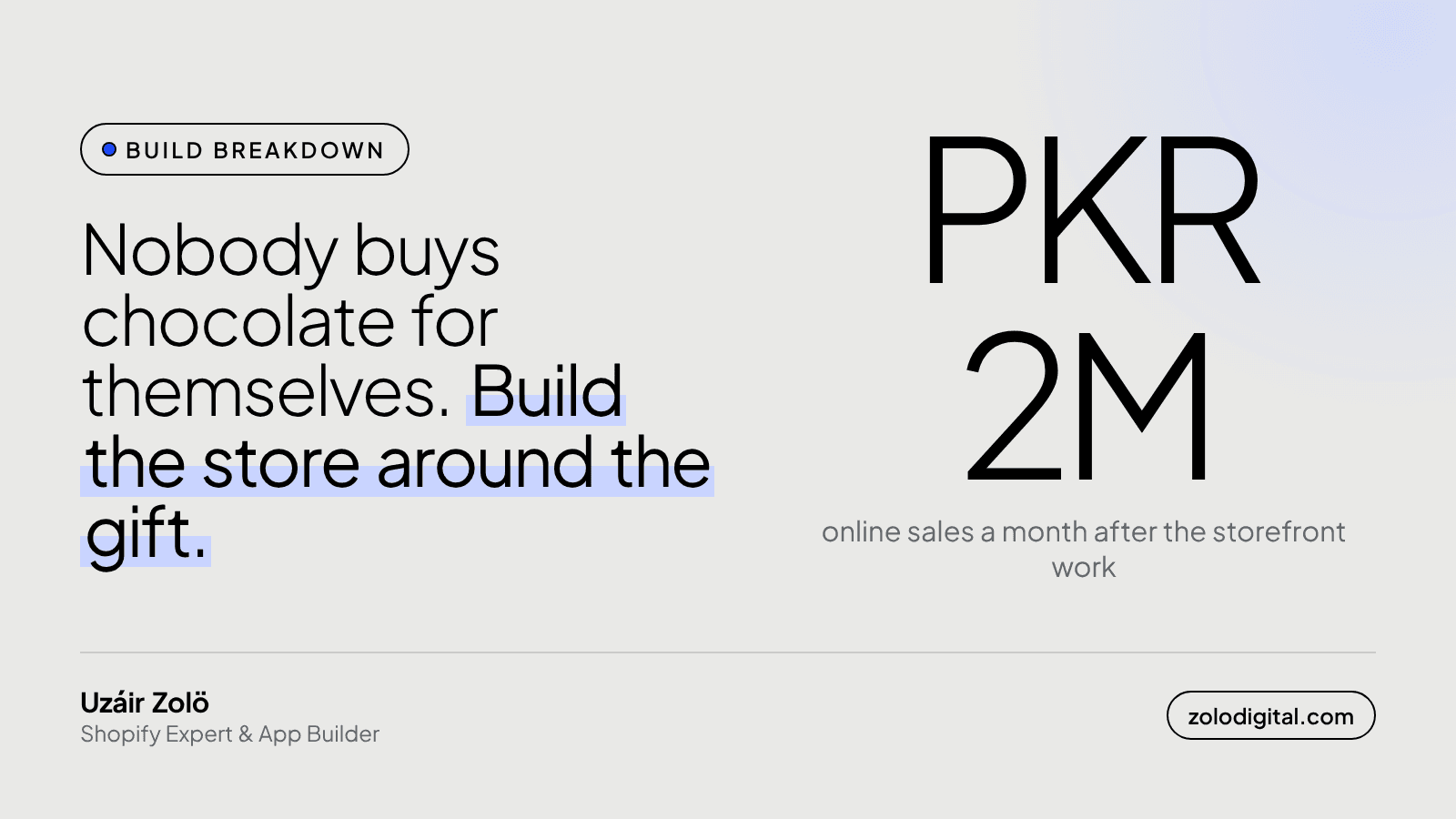
In 2022, as senior developer at SIAR Digital, I worked on the Shopify storefront for Lals Chocolate, a chocolate and gifting brand selling online in Pakistan and the UAE. The brief was a catalogue built around occasions and gifting rather than a plain product list, and the work was adapting the theme to that. After the storefront work, Lals' online sales grew to PKR 2 million a month.
Below is how I approach a gifting store on Shopify today. It's the general playbook, not a tour of one client's admin.
Why doesn't a normal product grid work for gifts?
A product grid answers "what do you sell?". A gift buyer is asking something else. They're often not the person who'll eat, wear or use the thing, they may not know the brand well, and they usually have a date in mind. Make them work out which of forty boxes suits a colleague's farewell and they'll leave to buy flowers.
How do you organise the catalogue by occasion?
Keep products as they are and add a layer of collections on top:
- Occasion collections: Eid, birthdays, weddings, thank-you, corporate. Make them automated collections driven by a product tag or a metafield, so a new box lands in the right places when it's tagged, not when someone remembers.
- Recipient collections: for her, for him, for the team, for kids.
- Price bands: "under 3,000", "3,000 to 6,000". Gift budgets are decided before the browsing starts.
One product sits in several collections at once, which is exactly the point. Then put occasions in the main menu, ahead of product types.
{%- comment -%} Occasion chips on the product page, from a list metafield {%- endcomment -%}
{%- for occasion in product.metafields.custom.occasions.value -%}
  <a href="/collections/{{ occasion | handleize }}">{{ occasion }}</a>
{%- endfor -%}
How do you handle gift messages and delivery dates?
Ask at the cart, once, not on every product page.
- Gift message: a cart note or a cart attribute (
attributes[Gift message]) shows up on the order, so the packing team sees it without anyone forwarding a WhatsApp. - Delivery date: if the brand delivers itself, a date field as a cart attribute works. If couriers handle it, show the order cut-off instead ("order by 2 PM for next-day delivery in Karachi") and only promise what the courier actually does.
- Gift wrap: a cheap product added as a line item is simpler and more reliable than a theme hack, and it shows up in reports.
What should a gift product page say?
Lead with the moment and the box: what's inside, how many pieces, how it arrives, how long it keeps. Ingredients and allergens still belong on the page, lower down and easy to find. Good photos of the packaging matter more than usual, because the packaging is half the gift.
What about selling in two countries?
If you sell in Pakistan and the UAE, Shopify Markets gives each country its own currency and prices. Occasions overlap but delivery doesn't, so cut-off times and delivery notes should change with the market, not sit in one hard-coded banner.
The short version
Ask why people buy before you touch the theme. For gifting that's occasion, recipient and deadline, and every part of the store should answer one of them.
If your store sells gifts and still reads like a price list, I build and rework Shopify stores for exactly this. Or get in touch and tell me what your customers are usually celebrating.


